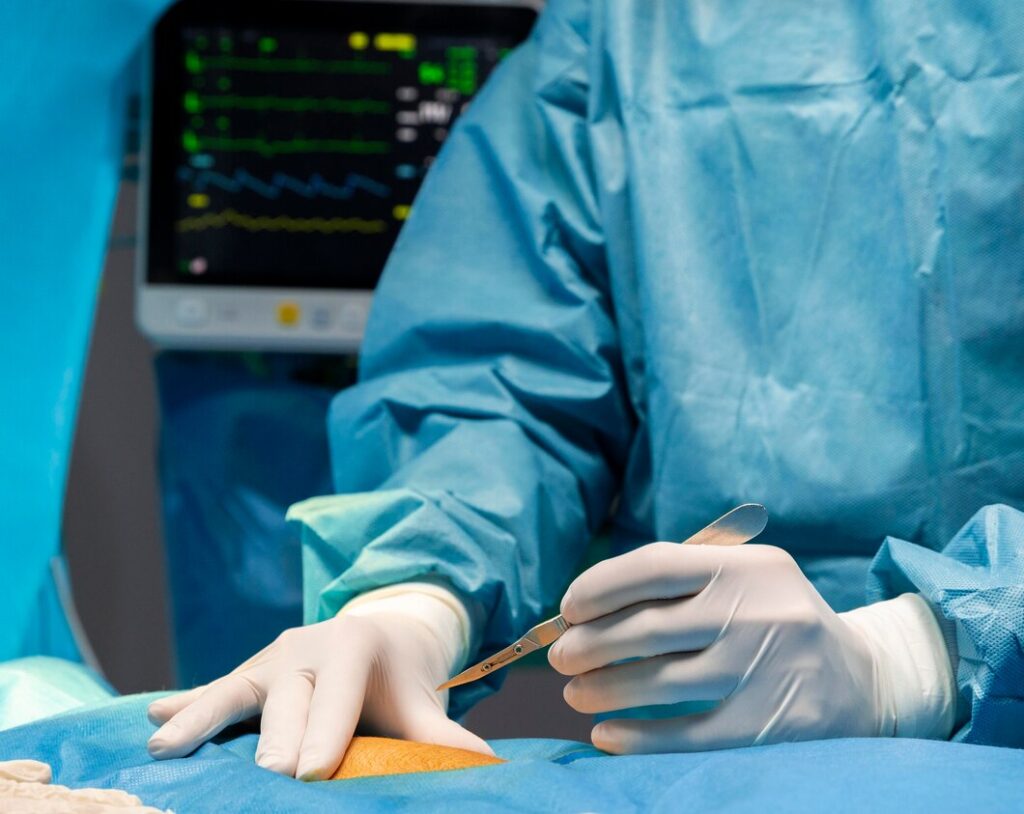
What is a USG-guided abscess drainage or catheter placement procedure?
A USG-guided abscess drainage is a minimally invasive procedure done under ultrasound guidance to remove pus or infected fluid collected in any part of the body.
When continuous drainage is required, a catheter (thin flexible tube) is placed into the abscess cavity under ultrasound control to allow the pus to drain out over a few days.
At Mitra Diagnostics, this procedure is performed by experienced interventional radiologists using real-time ultrasound imaging for safe and precise placement.
Why is this procedure needed?
Your doctor may recommend this procedure if:
You have an abscess (pus collection) in the liver, kidney, pelvis, abdomen, chest wall, or soft tissues
Antibiotics alone are not resolving the infection
Imaging (CT or ultrasound) shows a localized fluid collection.
To relieve pain, swelling, and fever caused by infection
To avoid open surgical drainage and promote faster recovery.
How does ultrasound guidance help?
Ultrasound provides real-time imaging of the abscess and surrounding organs.
This allows the radiologist to:
Choose the safest route for needle or catheter insertion
Avoid injury to nearby blood vessels or organs
Ensure complete and accurate drainage
Why choose Mitra Diagnostics for USG-guided procedures?
Experienced interventional radiologists
High-resolution ultrasound equipment for precision
Strict sterile technique and patient safety
Quick recovery and minimal discomfort
Facility for ultrasound-guided FNAC, biopsy, and aspirations
– You may feel mild pressure or discomfort when the catheter is inserted, but no sharp pain.
– The procedure is generally well-tolerated and much less painful than surgery.
How is the procedure performed?
You’ll lie comfortably on the scan table.
The skin over the affected area is cleaned and sterilized.
Under ultrasound guidance, a small needle is inserted into the abscess.
The pus or fluid is aspirated (removed) and sent for laboratory culture.
If continuous drainage is required, a catheter is placed and connected to a drainage bag.
The catheter is secured and covered with sterile dressing.
The entire procedure usually takes 20–40 minutes.
Is hospital admission required?
– Many cases can be done as a day-care procedure.
– If the infection is severe or catheter drainage is required for several days, short hospital admission may be advised for observation and antibiotics.
How long does the catheter stay in place?
– Usually for 2–5 days, depending on the amount of pus and the healing progress.
– The catheter is removed once the drainage stops and follow-up ultrasound confirms resolution.
Are there any risks or side effects?
USG-guided drainage is very safe, but rarely:
– Mild pain or bruising at the puncture site
– Minimal bleeding or leakage around the catheter
– Infection at the insertion site (prevented with sterile precautions)
All procedures at Mitra Diagnostics are done under strict aseptic conditions to minimize any risk.
What are the benefits of USG-guided drainage compared to surgery?
– Minimally invasive (no large cut or stitches)
– Faster recovery and shorter hospital stay
– Less pain and scarring
– Lower cost than surgery
– Can be done under local anaesthesia
– Accurate and safe due to real-time imaging
Can the drained fluid be tested?
Yes. The collected fluid or pus is sent to the laboratory for:
– Culture and sensitivity test (to identify bacteria and choose the best antibiotic)
– Cytology or biochemistry (if required for diagnosis)
What care is needed after the procedure?
– Keep the catheter site clean and dry.
– Do not tug or twist the drainage tube.
– Report any fever, redness, or increased pain to your doctor.
– Continue prescribed antibiotics and follow-up scans as advised.
When will I get my report?
– An ultrasound report describing the abscess and procedure details is provided immediately after the procedure.
– Fluid culture reports take 2–3 days depending on the lab results.
Summary
USG-guided abscess drainage or catheter placement is a safe, minimally invasive alternative to surgery for removing infected fluid collections. At Mitra Diagnostics, we perform this under expert supervision, ensuring precision, safety, and faster healing.